


Dear reader: in early 2025, I took a real job.
Part time, local, decent pay. It meant I could keep freelancing with the security of a steady income should all else fail. This is important when you are trying to, for example, buy a house. It was the right thing at the right time.
But it was also unimaginably shit. I caught a violent case of Mondayitis. My health and fitness got knocked to the mat. My ego and my mental health took an even bigger hit. It even affected my social life.
This year, I’m fortunate enough to return to full-time freelancing. Rather than putting 2025 into a Things I Don’t Want To Talk About file, I realised I ought to do something positive. Sharing my experience might help someone else who finds themself facing a freelancer’s worst nightmare: taking a real job.
How it started
Having to get a real job is a situation I am sure most freelancers will face at least once in their career. The peaks and troughs of working for yourself can be very spiky and sometimes life requires something steady.
By a ‘real job’, I mean a pretty ordinary job. Run of the mill, let’s say. We’re not talking about your ‘dream job opportunity’ here. It could be like a job you had in the past, or it could be a new industry. The sort of situation that makes you go “well, if needs must…”.
My situation? I’m not a fan of sharing much personal stuff on the internet, so I’ll keep this broad. But when you’ve got a family and you live in New Zealand, you face extraordinary pressure to buy a house. That’s pretty hard to do as a freelancer.
Compounding things, business really began to slow in 2024: blame a poor economy, AI, whatever - it was starting to look bleak. New projects were getting smaller and taking longer, and nobody seemed interested in retainers or long-term engagements.
A friend, who had just taken over leadership in a local business, shoulder tapped me to apply for a marketing role. She was aware of the situation and genuinely wanted to help, and while I was wary of working with a friend, I decided to go for it.
The Okay, the Bad, and the Ugly
Just to manage your expectations, this is not going to be a full exposé about a toxic workplace or corporate malfeasance.
Firstly, it wasn’t that bad.
Secondly, the reality is that any job you take will be broadly okay. There will be crap and politics and toxicity, but there will also be laughter and good people. And a regular payment into your bank account.
So I’m not going to dunk on the place, but I’m also not going to name it. If you figure it out, keep it to yourself.
It was a marketing role, though it quickly became yet another example of a job that exists almost entirely outside its description. Of the ten bullet points in the ‘role requirements’ section, I spent 90% of my time on just one: “other tasks as required”. Almost all of that was fixing problems with automations and platforms.
In fact, ChatGPT did most of the work I wanted to do and wrote 99% of everything this business published. I spent so much time on the systems stuff, and the content requirements were so vast, that ChatGPT was the only way I could tick off the other 9 bullet points on the list.
I got very good at prompting it, and a very good look at its limitations.
This, I fear, is what a lot of Real Jobs are becoming. For one thing, ChatGPT and Gemini are absolutely useless at ‘creative problem solving’. From slightly off to downright misleading, their solutions to most problems were totally wrong.
The result is that we humans fixed the computer things, and the computer thing did the human work.
Unfortunately, my complaints amounted to little more than screaming into the void. It was more than a little scary to see how much some businesses already rely on ChatGPT et. al. for their marketing and communications. Scary stuff.
The good

There were some positives, of course. An overseas trip. Learning about a different industry. Seeing with my own eyes just how much people loved the product. Meeting genuinely lovely people that I would never otherwise encounter.
There was another big positive: we did manage to buy a house. The steady employment facilitated a big life moment. The selfish part of me, which felt like I had made a dutiful sacrifice rather than an empowering choice, could pipe down.
The ends justified the means.
The ego battle
One of the hardest things was trying to rebalance my ego. While I’d like to call it something like “skills and experience” or even better “expertise”, it’s probably fairer to call it ego.
I’m no brain scientist but my basic understanding of an ego is that it’s your sense of self, or your understanding of what separates you from everyone else. Part of that is your self-worth, which - in a work sense - we freelancers need plenty of.
Being a successful freelancer requires a good sense of self and self-worth. It gives you the confidence to do good things, to show people how good those things are, and to then talk about those good things so that more people talk to you.
It’s in a your own interest to do better, which is why so many great freelancers rise to the top of their fields. Freelancers can own more of their success.
But a real job requires rebalancing your ego quite significantly. You’re still the same valuable person, but your value to your employer is a much more complex equation.
Working for someone else is like having to keep a fire going: you just keep putting bits of wood in, they keep burning, and you do it forever.
Sure, you might come up with better ways of putting wood into that fire. You might design the world’s most efficient method of putting wood into that fire, some kind of complex honeycomb system that burns for 11% longer than the ‘chuck it and see’ method.
But an employer does not care how artfully you stack. An employer does not (even if it says so in the job ad) want someone who is a creative problem solver. An employer loves your enthusiasm but wants to you research better-burning woods in your own time. An employer will not take it well if you ignore the way they want something done, even if the result is promising.
Why? Because they wear the risk if it falls apart. An employer certainly does not want to hear you say that a heat pump would be more efficient.
They just want someone who keeps that fire burning.
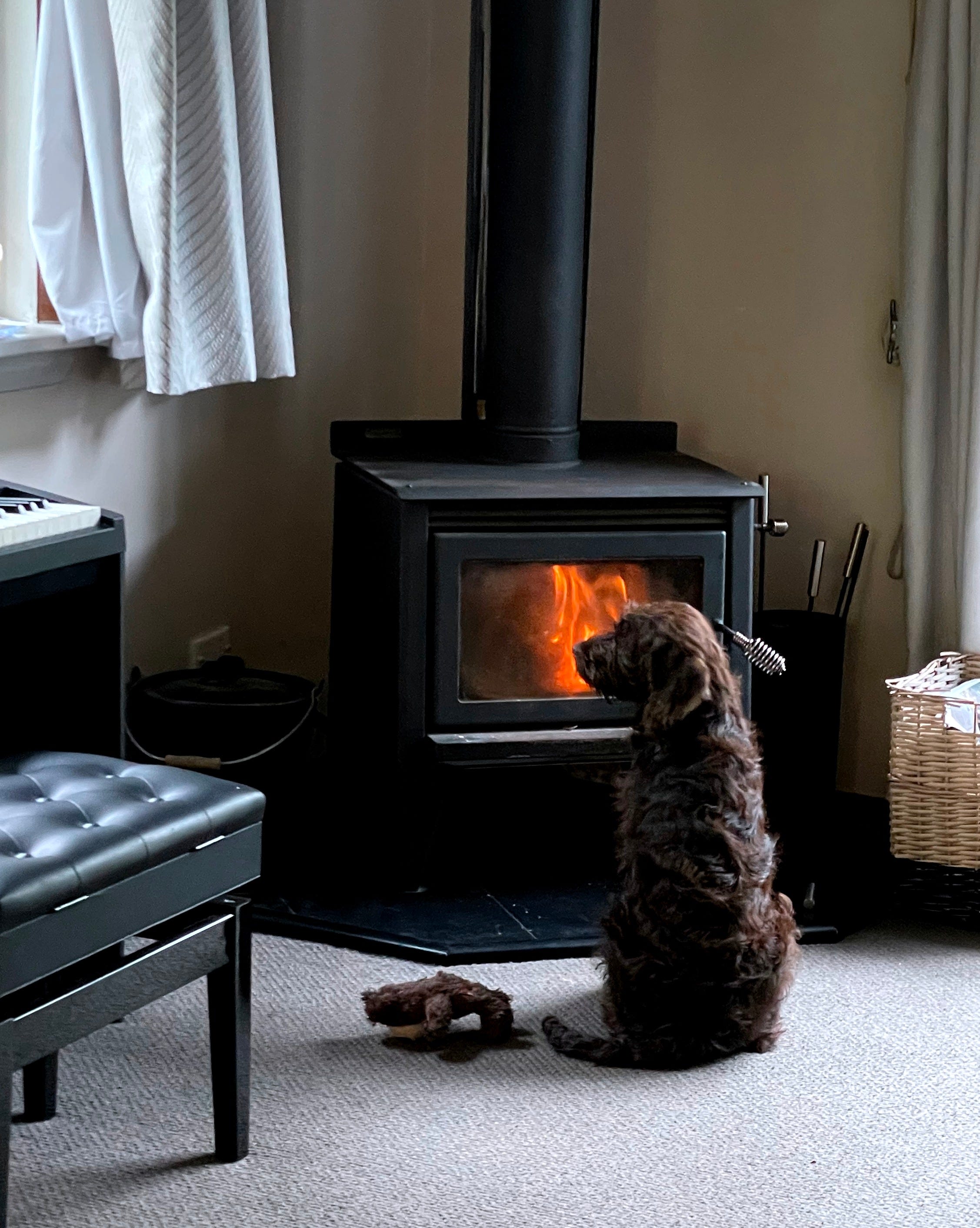
That’s why your valuable self doesn’t matter. Most of the time, what an employer values is the role, not the person.
This could be because job descriptions are perpetual, while most freelance work has an end point.
For a freelancer, it can be really hard to get used to a job that is never ‘finished’. I love a finish line. Project based work suits me. Even with my long-term clients, it’s all about projects.
There’s no easy way to say this: if you live for the handover, a real job is going to be a challenge. Prepare yourself for working on - and probably never really finishing - a million things at once. Prepare yourself for compromising on most of them, too, and for having to go with the MVP rather than polished perfection.
How I got out
Only a couple of months into the job, I got a call from someone at an agency I’ve worked with a few times, asking whether I could take on more work. It was all a bit vague, but I - importantly - said “maybe”.
How I was going to make it work, I do not know, but I think “maybe” is an important tool to wield.
It took about 9 more months for something to come of that phone call. Phone calls begat meetings begat a proposal begat, eventually, a contract.
But what’s important about this story is that it’s like a cicada life cycle. Because, you see, what popped to the surface in November of 2025 started life many moons ago. The client got my details from a creative director I haven’t worked with for years. Then, when a different agency mentioned me, they decided to get in touch.
Those eggs were laid years ago (I think that’s how cicadas work). That passive voice is intentional: this is not work I was actively looking for. But, by doing a few good jobs and by staying in touch with different CDs/agencies even without work on, I stayed top of mind.
That’s advertising 101.
The opportunity was a surprise and yet it was also the very long-term pay off. Don’t neglect those networks, and stay visible. Even if you’re going full-time, try to keep an eye out for future you.
And if you’re reading this and not even considering a job, heed the advice anyway. Try to plant seeds (or lay eggs?) everywhere you can, and then nurture them. Stay in touch. Check in every year with an email. Pop into the office and say hello, or meet for a coffee.
There is quite literally not a single reason not to.
Why I kept it quiet
When I accepted the job, I told as few people as possible. Partly it was embarrassment. I didn’t want to have those conversations about how times are tough, probably because it felt like failure. This might all be in my head, but I’m pretty sure it’s not unusual.
Looking back, I spent the last year pretty depressed. Waves of it would hit me on Sunday evenings and last at least a couple of days. A lot of the things I value about freelancing went out the window because I lacked the time and the energy.
One of those things was weightlifting. I love weightlifting: the zen-like total focus, the chance to exercise my body rather than my mind, the primal thrill of moving big bits of steel around. But I pretty much gave it up, going to the gym once a month if I was lucky. It became a negative cycle, because I started going backwards, which killed my motivation.
Likewise, music took a back seat. One of my break rituals as a freelancer has always been to pick up a guitar and play a song or just noodle around, but that stopped. It felt like my hands atrophied, and my ears.
Long-distance cycling also stopped entirely. Cooking for anything other than an impending meal. Lying down on the floor to think.
This is all sounding a bit dark, but it’s meant to be a cautionary tale. Because I really was trying to have my cake and eat it too: I never really accepted life as it was, which meant I kept trying to live in a way that wasn’t working.
Had I accepted the situation and adapted to it, I probably would have felt a lot happier - and had the energy to keep doing at least some of what I love.
One strange feeling that crept in was guilt, and it crept in through a strange spot: the Brave New Word podcast. It’s corny, but I felt like I was doing a disservice to anyone who listened. I was pretending I was in freelance bliss while actually, I was in a real job and pretty deep depressive pit. It also felt wrong to be giving advice because I felt like a fraud. Call it heightened impostor syndrome.
It’s probably also because I know that media - especially the social kind - really distorts how we perceive the world. Everyone looks happy, beautiful and successful. We rarely see failure or even just normalcy, especially on LinkedIn. I didn’t like that I was contributing to that for the sake of preserving my brand.
I’m probably not at “apologising to strangers” stage yet. But I do intend to do better from now on by being more candid and thoughtful in what I write and share. Young, fresh-faced freelance me would have appreciated reading that kind of stuff.
You’ll be okay.
If you are standing on the precipice of taking a real job, or you’re actively looking for one, I don’t have any powerful motivational quotes or advice. I just want to say one thing:
You’ll be okay.
It might feel like you’re giving up. Worse, like you’re losing part of yourself. I realised how much my identity was tied to my freelance business. For better or worse, being a freelance copywriter is a big part of how I see myself and the world. Taking that job rocked me to the core. I felt like I was losing my ability to write, exacerbated by having to use ChatGPT all day, every day in the job.
I found it really hard. I don’t think many people really understand it. No matter how patient and loving the people around you are, it’s impossible to understand how crap it feels to take a real job when you’ve been a freelancer.
I was fortunate that an opportunity came up, and I was fortunate it meant I could ditch the job with my wife’s apprehensive but forever supportive blessing.
It took a year, and I still say that’s lucky. You might be in it for a longer haul.
But you’ll be okay.
Feel free to comment below or reach out if you’re in the throes of taking a real job. Especially if you’re feeling those dark clouds descending: I’ve been there, so let’s talk.
Holy smokes! Are we twins? No word of a lie, I've just had (almost word for word) the same experience as you. Except I only lasted 5 months before the phrase "I simply cannot go on" tumbled out of my mouth... to my boss.
It was really heartening to read your story because it validated what I've been going through. I've been beating myself up for months, thinking I can't "hack it" when really, I'm just not designed for a "real" job. I'll even go so far as to say that marketing jobs look sexy from the outside, but they're the closest thing to hell I've ever experienced. I'm glad you're back freelancing again... and hope you've hit some new PR's in the gym :)